
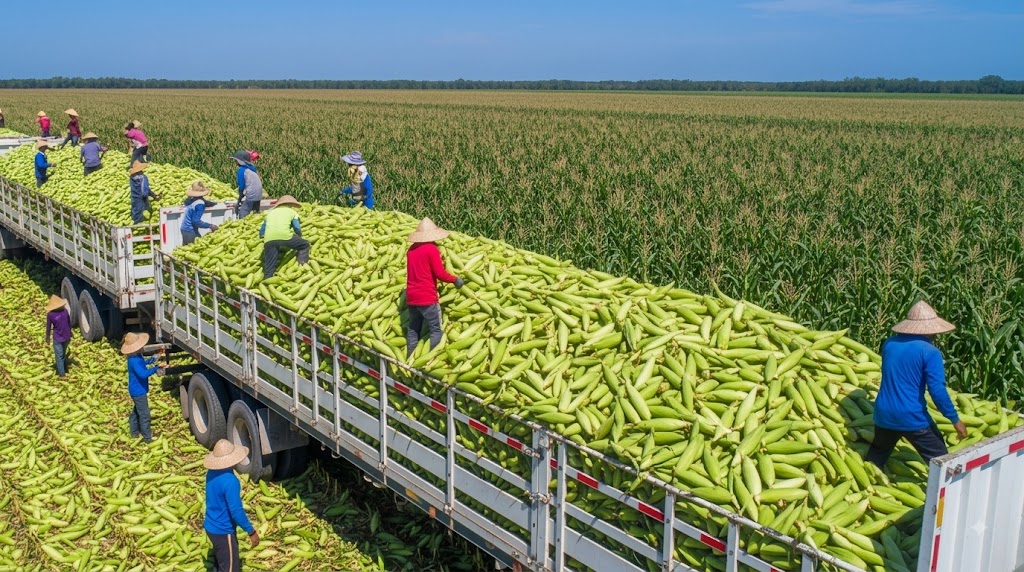
Every day, somewhere on the planet, machines and human hands are bringing in a harvest big enough to feed billions of people and most of us never see how it actually happens. From massive combine harvesters cutting through wheat fields in Kansas to workers hand-tapping rubber trees in Thailand, harvesting methods vary wildly depending on the crop, the country, and how much of the process can safely be automated.
This guide breaks down 33 of the world’s biggest harvests, organized by category, along with the country that leads global production for each one and roughly how much it produces every year. Whether you’re a fellow grower curious about methods used elsewhere, or just someone who wants to understand where your food actually comes from, this is a look at agriculture at a scale most people never see.
Quick Reference: 2026 Global Harvest at a Glance
| Crop | Leading Country | Annual Production |
|---|---|---|
| Wheat | Kansas, USA | 7–10 million metric tons |
| Corn | USA | 350–390 million metric tons |
| Potatoes | China | 95 million metric tons |
| Sugar Beets | France | 30–35 million metric tons |
| Almonds | California, USA | 80% of world supply |
| Apples | China | 45+ million metric tons |
| Mangoes | India | 25–27 million metric tons |
| Bananas | Ecuador | 6+ million metric tons |
| Sugarcane | Brazil | 700–750 million metric tons |
| Coffee | Brazil | 3.5–4 million metric tons |
| Cacao | Côte d’Ivoire | 2.2–2.5 million metric tons |
| Natural Rubber | Thailand | 4.5–5 million metric tons |
Field Crops & Vegetables
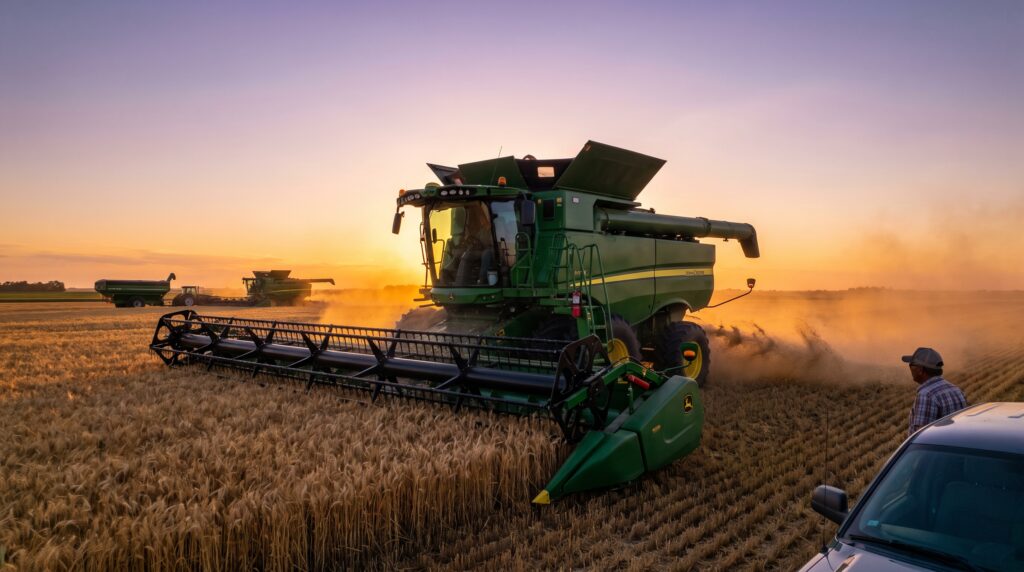
Field crops are the foundation of the global food supply, and they’re also where mechanization has gone the furthest. Wheat in Kansas is cut with combine harvesters that thresh and separate grain in a single pass, while corn uses specialized headers that snap ears off the stalk and strip the kernels clean, with the US alone producing 350 to 390 million metric tons a year.
Not every field crop travels the same path. In Vietnam, rice is combined and bagged directly in the field. Meanwhile, China, the world’s top potato producer at roughly 95 million metric tons annually, specialized harvesters dig through soil and shake potatoes free from the dirt as they go.
In Germany Machines pulls carrots by their leafy tops to keep the roots undamaged, while the Netherlands spreads freshly pulled onions across the field to cure in the sun, toughening the skin so they store for months. France’s sugar beet harvest, 30 to 35 million metric tons a year, is a race against time, since sugar content starts dropping the moment the beet leaves the ground. Pumpkins in the US round out the category, moved by conveyor or hand-picked depending on whether they’re headed for carving or processing.
Pro tip: if you’re growing root vegetables like carrots or onions on a smaller scale, timing your harvest for dry weather makes a noticeable difference in storage life, the same principle that drives the Netherlands’ onion-curing process at commercial scale.
Fruit Orchards
Orchard crops tell a different story. The more delicate or valuable the fruit, the more likely it’s still harvested by hand, even in countries with heavy investment in agricultural technology. California supplies about 80 percent of the world’s almonds using hydraulic shakers that knock nuts to the ground to dry, but China, the top apple producer at over 45 million metric tons a year, still hand picks apples one at a time to avoid bruising.
That pattern holds across most fruit. Chile’s cherries, the country is the largest fresh exporter in the world, are hand-harvested to keep the stem attached and the skin unbroken. India picks mangoes with poles or clippers rather than letting them drop. Vietnam hand-cuts dragon fruit from its cactus-like posts, and Thailand times its durian harvest, 1.5 to 1.7 million metric tons a year, around exact ripeness or natural fall. Ecuador’s bananas move from cutting to packing entirely on overhead cable systems, while the Philippines’ pineapple harvest is one of the most labor-intensive on this list, with experienced workers hand-cutting close to a thousand fruit a day. France mechanically harvests wine grapes using gentle vibrating rods, Spain shakes olives onto nets and rushes them to press for 40 to 45 percent of the world’s olive oil, and Mexico hand-cuts every avocado with the stem intact to slow spoilage.
Pro tip: fruit that bruises easily rarely benefits from mechanical harvesting at any scale it’s one of the clearest patterns across every country in this list, and worth keeping in mind if you’re weighing equipment investment against hand labor for a fruit crop. Data benchmarks compiled via the United Nations FAOSTAT Database and global fruit export tracks.
Cash & Specialty Crops
Specialty crops show the widest range of methods in the entire harvest. Brazil’s sugarcane, 700 to 750 million metric tons a year, is now almost entirely mechanized, and Brazilian coffee, 3.5 to 4 million metric tons annually, uses mechanical harvesters that shake ripe cherries from the branch. Compare that to Côte d’Ivoire’s cacao, where every pod is still cut by hand with a machete to protect the buds that will produce next season’s crop, or Thailand’s natural rubber, harvested by tapping tree bark and collecting latex drop by drop, a method that has barely changed in over a century.
Quality-sensitive crops lean hand-picked almost across the board. China’s tea harvest takes only the tender young buds by hand, Vietnam hand-strips black pepper clusters from the vine, and Vietnam’s cashew harvest is almost passive, with workers simply collecting nuts from the ground after the fruit falls naturally. The US cotton harvest, 3 to 4 million metric tons a year, compresses fiber into massive field-side modules by machine, while Mexico’s chili pepper harvest, over 3 million metric tons annually, still relies on individual inspection since color and ripeness matter so much. Italy hand-cuts artichokes before the bud opens, Peru’s asparagus has to be harvested daily because of how fast it grows, lavender is cut at peak oil content for distillation, and mushrooms close out the list grown entirely indoors in temperature-controlled environments, disconnected from soil, season, or weather altogether.
Pro tip: as a general rule, the crops still harvested by hand are the ones where a few seconds of delay or a small amount of pressure changes the final quality that’s true whether you’re growing a few artichoke plants or managing a commercial cacao farm. Data benchmarks compiled via the United Nations FAOSTAT Database and global fruit export tracks.
Harvest Method Checklist: Is Your Crop a Candidate for Mechanization?
- The crop has a tough outer skin or shell that resists bruising
- Ripeness is fairly uniform across the field or orchard at harvest time
- Quality doesn’t depend on individual inspection (color, firmness, stem intact)
- You’re harvesting at a scale where labor costs outweigh equipment costs
- The crop doesn’t need daily or same-day harvesting like asparagus
- Post-harvest processing can happen quickly enough to preserve quality
If most of these apply to your crop, mechanization is worth exploring. If several don’t, hand-harvesting is likely still your best option for quality, at least until the crop reaches a much larger commercial scale.
FAQ
Which country produces the most food overall from this list? Brazil stands out with both sugarcane (700–750 million metric tons) and coffee (3.5–4 million metric tons) among the highest-volume harvests covered here.
Why are some crops still harvested entirely by hand despite modern farming technology? Mechanical harvesters can’t yet replicate the judgment needed to avoid bruising delicate fruit, select only ripe produce, or protect a plant’s future growth, which is why crops like cacao, cherries, and tea remain hand-picked even at large commercial scale.
What’s the fastest-growing crop that needs daily attention? Asparagus. It grows quickly enough that Peru’s farms, among the world’s top producers, have to harvest it every single day during the season or the spears grow past their ideal size.
Is mechanized harvesting always better for farmers? Not necessarily. Mechanization reduces labor costs and speeds up harvest, but it isn’t suitable for every crop, and hand-harvesting still produces higher quality results for fruit and specialty crops where bruising or ripeness selection matters.
Which crop has the most unusual harvesting method? Natural rubber. Unlike anything else on this list, it isn’t picked at all workers tap the bark of the tree and collect latex as it slowly drips out over time.
How is mushroom farming different from every other crop on this list? Mushrooms are grown entirely indoors in temperature and humidity-controlled environments, completely separate from soil, weather, or seasonal timing, which makes the process closer to manufacturing than traditional farming.
Watch the Full Documentary
For the full visual breakdown of all 33 harvests featured in this guide, watch the complete documentary on the Smart Farm Insights YouTube channel.
If you found this breakdown useful, you can find more articles like this one covering farming techniques, equipment, and crop production from around the world at SmartFarmInsights.com. New guides go up regularly, so it’s worth checking back or subscribing to stay updated.
How California Farmers Harvest Millions of Tons of Fruits and Vegetables: The Complete 2026 Guide